
Some games announce themselves immediately as something different. Balatro, the roguelike deckbuilder built around the skeleton of poker by solo developer LocalThunk, had no such dramatic entrance. It arrived in February 2024 with a quiet trailer, a modest price tag, and a premise that sounded, on paper, almost perversely simple: play poker hands to score points and meet escalating chip targets. That summary is both completely accurate and entirely insufficient to describe what Balatro actually is, which is one of the most compulsively replayable, elegantly designed, and genuinely dangerous pieces of interactive entertainment to emerge in years. Dangerous is not a word used lightly here. This is a game that has eaten weekends, dissolved to-do lists, and convinced reasonable adults that two in the morning is a perfectly sensible time for one more run.
The story of Balatro's creation is itself remarkable. LocalThunk, whose real identity remains publicly unknown, developed the game over several years in near-total secrecy. The result demonstrates what a single developer with a singular vision and years of patient iteration can produce — something more precisely tuned and more fundamentally satisfying than games made by teams ten times the size with budgets to match. Balatro shipped with effectively no bugs of consequence, a depth of content that took the community months to fully map, and a quality of feel in every interaction that suggests hundreds of hours of refinement that never appeared in any changelog.
Poker as a Foundation, Not a Destination
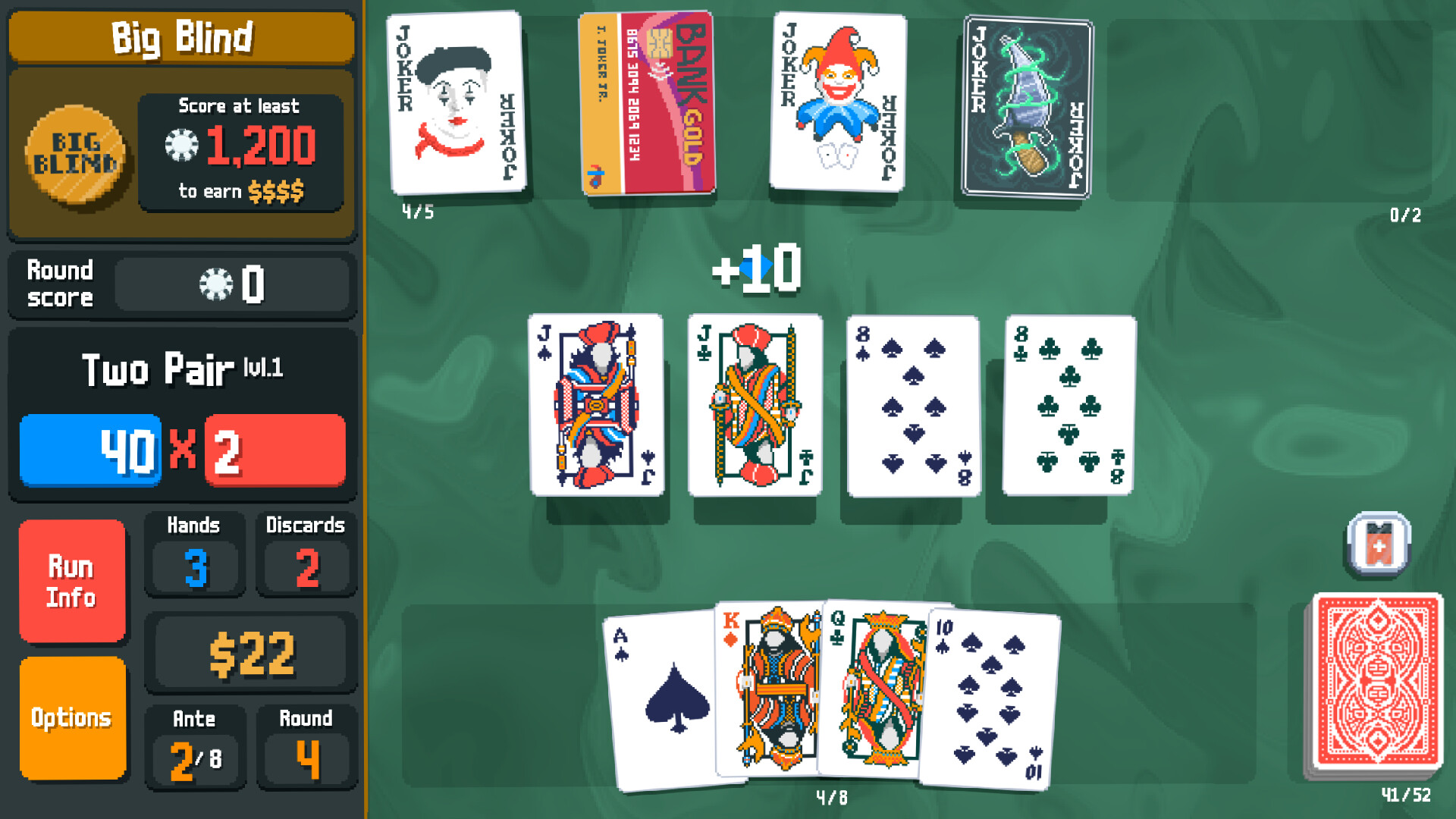
Understanding Balatro requires first understanding what it borrows from poker and what it discards. The hand rankings are intact: high card, pair, two pair, three of a kind, straight, flush, full house, four of a kind, straight flush, royal flush. These hands earn you chips and multipliers according to a base table that you can expand by levelling up individual hand types. But Balatro is not a poker game in any meaningful competitive sense — there are no opponents, no bluffing, no reading of tells. The cards you hold are yours alone, selected from a deck of your own construction, played in whatever combination you choose from the seven dealt to you each blind.
What Balatro is, beneath the poker veneer, is a synergy engine. The true game begins with jokers — special cards, up to five at a time, that modify how your hands score. A joker might add chips for each heart in your hand. Another might multiply your score whenever you play a pair. A third might trigger an effect for every card you discard during a round. Individually these effects seem modest, almost underwhelming. The revelation that Balatro engineers — and it does this better than almost any game in recent memory — is that individually modest effects become extraordinary in combination, and discovering those combinations is the game's central creative act.
The mathematics of exponential multiplication can take a hand that should score a few hundred chips against a target of a few hundred and transform it into a cascade of millions. The moment this clicks — the first time you watch a single three-of-a-kind punch through a target of forty thousand because three jokers are whispering to each other in a language you've only just learned — is one of the most satisfying in modern game design. It's not that the numbers are impressive, though they are. It's that you built this. You identified the pieces, assembled the engine, and now you're watching it run.
The Joker Economy
Jokers are acquired in the shop between each round of blinds. The shop offers a rotating selection of jokers, consumable cards (tarot and planet cards), and booster packs that expand your deck with new standard cards. Money management is its own strategic layer — jokers cost varying amounts, and holding money earns interest at the start of each ante, creating a push-pull tension between buying now and banking for a larger purchase later.
The joker pool is vast. There are over one hundred and fifty of them across multiple rarities, from common jokers with simple additive effects to rare and legendary jokers that fundamentally restructure how a run works. Some jokers care about suits. Some care about hand size. Some care about what cards you discard. Some trigger on specific number values, others on the face cards, others on the order in which cards are played. The depth of the pool ensures that no two runs feel identical, and the rarity system ensures that the game withholds its most powerful and unusual options until they can genuinely surprise you.
Consumables, Deck Construction, and the Art of Refinement
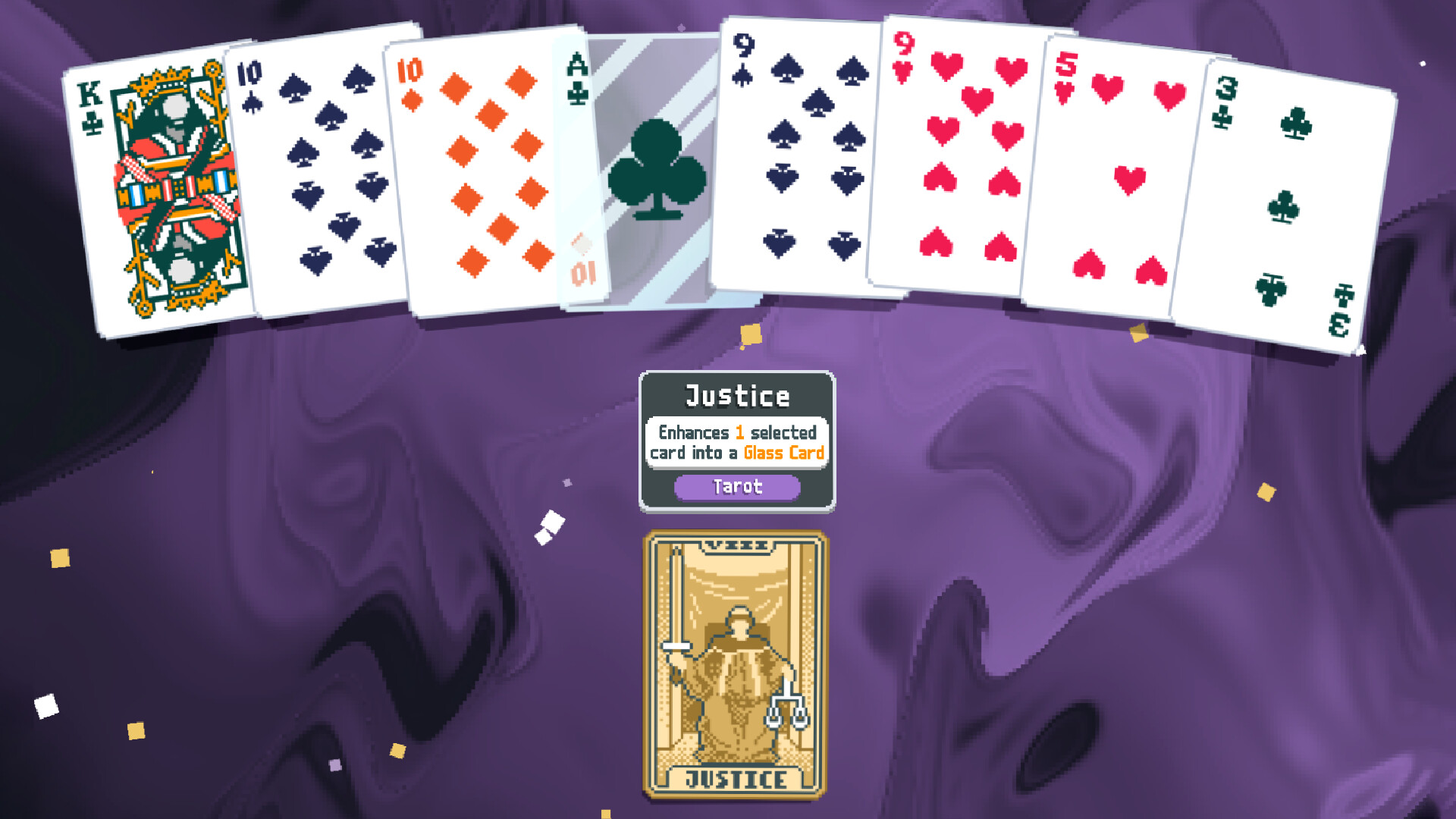
Alongside jokers, Balatro features two categories of consumable card that give each run its texture and direction. Tarot cards apply direct modifications to cards in your deck — enhancing them, changing their suits, upgrading them to higher value faces — or to the jokers in your collection. Planet cards level up specific hand types, improving their base chip and multiplier values and making previously weak hands viable foundations for entire builds.
Deck manipulation is where Balatro reveals much of its depth. Standard cards can be enhanced with foil, holographic, or polychrome finishes that add chips, multipliers, or prismatic multipliers respectively. They can be given seals — red, blue, gold, or purple — that trigger effects when played or held. A single card might be enhanced, given a steel multiplier finish, and sealed with a red seal that retriggers its effects twice per play, and that single card can tip the balance of an entire run. Tracking the state of your deck — knowing which cards to hold, which to discard, which to search for — becomes a sophisticated mental exercise.
The ability to remove cards from your deck is equally important. Balatro starts you with a standard 52-card deck, and the ability to prune it — removing low-value number cards that dilute the distribution of high-value faces, or removing off-suit cards that weaken flush consistency — is as crucial as any joker acquisition. The game gives you ways to do this sparingly, making each removal decision feel weighty.
Run Structure and Difficulty
Each run consists of eight antes, each containing three blinds: a small blind, a big blind, and a boss blind. The first two can be skipped in exchange for a tag — a one-time bonus that might give you extra money, a free joker, or a modified shop — and the skip-or-play decision adds a layer of resource management that extends across the whole run rather than just each individual hand.
Boss blinds introduce modifiers that complicate your strategy. A boss blind might freeze one suit so those cards score no chips. Another might invert the scoring of hand types so your strongest hands become your weakest. Another might restrict you to playing only one hand per blind instead of the usual four. These modifiers are obstacles that a well-constructed deck navigates around, and they serve as difficulty checkpoints that punish passive strategies and reward adaptability.
The core game offers three difficulty settings. White stake is genuinely approachable for new players; red stake adds difficulty by requiring higher chip targets per blind; gold stake represents the game's hardest challenge, demanding builds of real sophistication. Beyond the standard run, gold stakes on each of the eight starting decks must be completed to fully unlock the game's content — a progression system that gives Balatro enormous longevity for players willing to push deep.
Starting Decks and Challenge Runs
Balatro ships with several starting decks that modify the rules in fundamental ways. The Abandoned Deck removes all face cards, forcing a complete reconceptualisation of what hands are viable. The Plasma Deck averages chips and multipliers together on each hand, rewarding balanced builds over spike-multiplier strategies. The Ghost Deck gives you a free spectral card each ante, enabling strange deck transformations unavailable in standard play. The Erratic Deck shuffles card values and suits randomly, creating runs of total chaos that some builds turn into extraordinary advantage.
On top of the base game, Balatro features an ever-expanding collection of challenge runs with specific constraints and win conditions. Some challenge runs give you a full set of jokers from the start but limit what you can acquire. Others invert the scoring rules or replace the standard deck with modified variants. These challenges are where the game's most experienced players spend most of their time, and they extend Balatro's replayability into territory that few roguelikes ever reach.
Presentation: Lo-Fi by Design
Balatro looks like a game running on a television set in a basement in 1985, and this is a deliberate, correct, and entirely successful aesthetic decision. The dark green card table, the glowing CRT scan lines, the chip values ticking up like an old slot machine — everything is tuned to communicate hypnotic focus. The visual design never competes for your attention when you're trying to do math in your head. It sits back and lets the numbers tell the story.
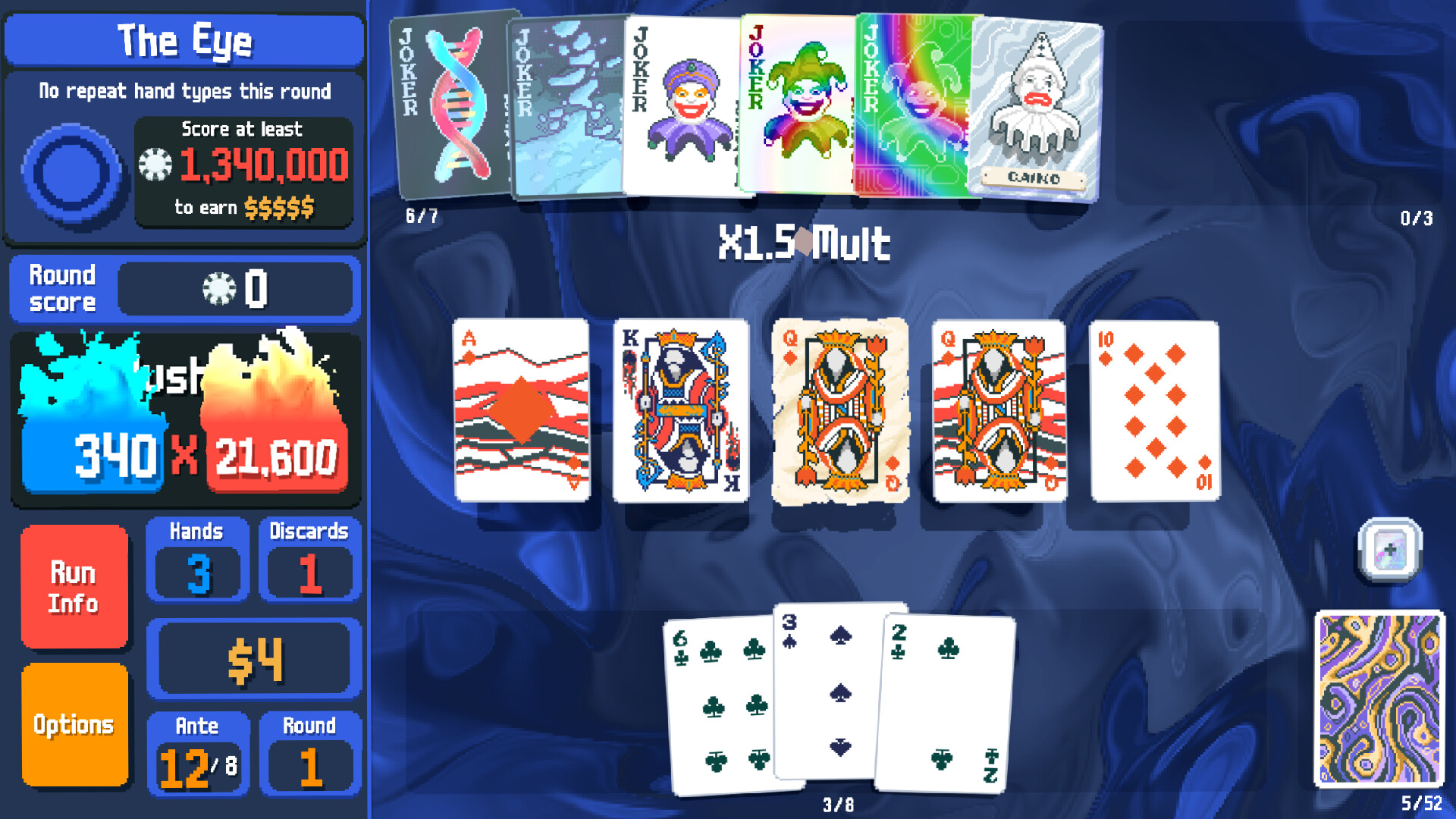
The card art for jokers is the game's secret visual achievement. Each joker has a distinctive illustration — cartoonish, expressive, sometimes absurd, always memorable — that communicates its function or personality at a glance. Iconic jokers like the Joker (the simplest of them all, a face with a permanent grin), the Baron (a regal figure who multiplies your kings when held in hand), and the Blueprint (a technical schematic that copies the joker to its right) have become fixtures of the game's visual identity. The entire joker library is a catalogue of tiny character designs, and building a collection of them across a run feels like assembling a strange team.
The soundtrack, composed by Leonard Ludvigsen, is jazz-inflected, loose, and perpetually present without ever becoming intrusive. The main menu theme sets the tone: warm, slightly smoky, the kind of music that sounds like it's coming from a speaker in another room. In-run tracks shift to more driving pieces during boss blinds without becoming aggressively pumping. It is mood music in the truest sense, designed to sustain the trance that Balatro induces rather than break it.
The Sound of Winning
Alongside the music, Balatro's sound design deserves specific recognition. Every card play, every joker trigger, every multiplier tick produces a satisfying audio cue. High-value chains of joker effects generate an escalating sequence of sounds that reward the ears as much as the eyes. The chip counter ticking up through millions produces a metronomic satisfaction that has been specifically designed to feel good.
The sum of these choices — the visual minimalism, the atmospheric music, the precise sound design — produces an experience that is comfortable in a way that many competitive or high-spectacle games are not. Balatro is not trying to overwhelm you. It is inviting you into a quiet room and asking you to think. The presentation sustains that invitation for exactly as long as you let it.
Mobile and Console Versions
Balatro launched on PC and subsequently came to Nintendo Switch, PlayStation, Xbox, and mobile platforms. The Switch version is a natural fit — this is quintessentially a portable game, the kind of thing that works as well in ten-minute bursts as it does in multi-hour sessions. The mobile version received some criticism at launch for lacking the full joker pool available on other platforms, though updates have progressively closed the gap.
All versions share the same core loop and feel. The touchscreen adaptation on mobile and Switch is competent, though mouse or controller inputs feel marginally more satisfying for the drag-select of cards. These are minor concerns. The game works everywhere it has been released.
Community and Meta-Game
Balatro has developed a devoted community that extends the game well beyond its single-player runs. Seed-sharing — entering specific run seeds to reproduce identical starting conditions for competitive play — became popular immediately. Speedrunning communities emerged and developed strategies for completing runs at maximum speed. Theory-crafters produced exhaustive guides to every joker, every synergy, every starting deck variant. The game's systems are deep enough to sustain this level of analytical engagement, which is its own form of validation.
LocalThunk has continued updating Balatro post-launch, adding content and quality-of-life improvements in response to community feedback. The willingness to continue developing the game, and to engage with the community that has formed around it, has extended Balatro's lifecycle substantially beyond what a static release would have achieved.
What Balatro Gets Right About Game Design
Underneath the practical discussion of mechanics and systems, Balatro embodies a set of principles about game design that are worth naming explicitly. It is a game of discovery — the systems reveal themselves gradually rather than front-loading tutorials, and the process of understanding them is itself pleasurable. It is a game of meaningful decisions — every shop visit, every card play, every discard has consequences that can be reasoned about rather than random outcomes that simply happen to you. And it is a game of authorship — the builds you construct are genuinely yours, products of your choices and preferences, and when they succeed the satisfaction is proportional to the investment.
These qualities, in combination, produce something that feels genuinely different from contemporaries in the roguelike space. Where many roguelikes create the illusion of agency through wide item pools but frequently produce runs that feel predetermined by early random drops, Balatro creates actual agency through systems that reward skill at every level of play. Beginners learn to construct basic synergies. Intermediate players learn to recognise and build toward powerful combinations. Expert players can extract wins from starting conditions that look hopeless on first inspection. The skill ceiling is genuinely high, and climbing it is the game's deepest pleasure.
Criticisms and Limitations
Balatro is not without its friction points. The very quality that makes it so engaging — the depth and interactivity of its systems — makes the early hours somewhat opaque. New players who don't intuitively grasp the exponential relationship between chips and multipliers may find initial runs feel like arbitrary failures rather than learning experiences. The game provides tooltips and information, but synthesis of that information into strategic intuition requires repetition, and not every player has the patience for that learning curve.
The absence of any narrative context is notable purely because it is unusual. Balatro is entirely focused on its systems, with no story, no characters, no progression narrative to hang the runs on. For players who need diegetic motivation — a reason within the fiction of the game to keep playing — Balatro offers nothing. The satisfaction is purely mechanical, and while that satisfaction is extraordinary, it is worth knowing going in that there is nothing else on offer.
Some players find the lo-fi visual aesthetic a barrier. The game's deliberate visual restraint reads as poverty of production to eyes accustomed to modern graphical complexity, and no amount of explaining that the aesthetic is intentional resolves this for someone who simply doesn't connect with it. This is a genuine limitation rather than a criticism — Balatro is not for everyone, and being honest about that serves players better than overselling.
Verdict
Balatro is one of the finest games released in the last decade, and the most compelling argument in years that a solo developer with a precise vision and relentless commitment to craft can produce something that competes with — and regularly surpasses — the output of studios of any size. It is elegant in the deepest sense: a simple premise, a set of carefully balanced systems, and an emergent complexity that rewards every level of engagement from casual to obsessive.
The roguelike genre has produced many excellent games in the last decade, but few have the quality of mechanical revelation that Balatro delivers. The moment a build clicks — the moment you understand why this joker and that joker and this enhanced deck are, together, going to solve every problem the game can put in front of you — is a designer's achievement of the highest order. LocalThunk built something genuinely rare: a game that feels impossible to fully exhaust and endlessly worth returning to.
One more run. Just one more run. You've heard this about other games and it was usually an exaggeration. With Balatro, it is simply the truth.