
FromSoftware has a tradition of making DLC that exceeds expectations. Artorias of the Abyss transformed Dark Souls' conclusion and introduced what many consider the series' finest boss. The Old Hunters remains the definitive expression of Bloodborne's themes, its world design, and its enemy encounters. The Ringed City gave Dark Souls III an ending commensurate with the trilogy's ambitions. In each case, the expansion did not merely add content to an existing game — it refined and deepened the experience, filling gaps and raising the ceiling of what the base game had achieved. Shadow of the Erdtree is FromSoftware's most ambitious DLC by a considerable margin, and it surpasses all of them.
Released in June 2024, nearly two and a half years after Elden Ring's original launch, Shadow of the Erdtree arrives at a moment when the community had thoroughly mapped every corner of the Lands Between and had begun to wonder whether any expansion could meaningfully add to what was already the generation's best open-world game. The answer is an unambiguous yes — not by doing something different, but by doing everything that made the original exceptional and then doing it better.
A World Apart: The Realm of Shadow
Access to the Realm of Shadow is gated behind two of the base game's most demanding boss encounters — Starscourge Radahn and Mohg, Lord of Blood. This is not an arbitrary requirement. The expansion is designed for players who have fully engaged with Elden Ring's systems, and the difficulty curve of its earliest areas is calibrated accordingly. New players who stumble in underprepared will find Shadow of the Erdtree more hostile than anything in the base game.
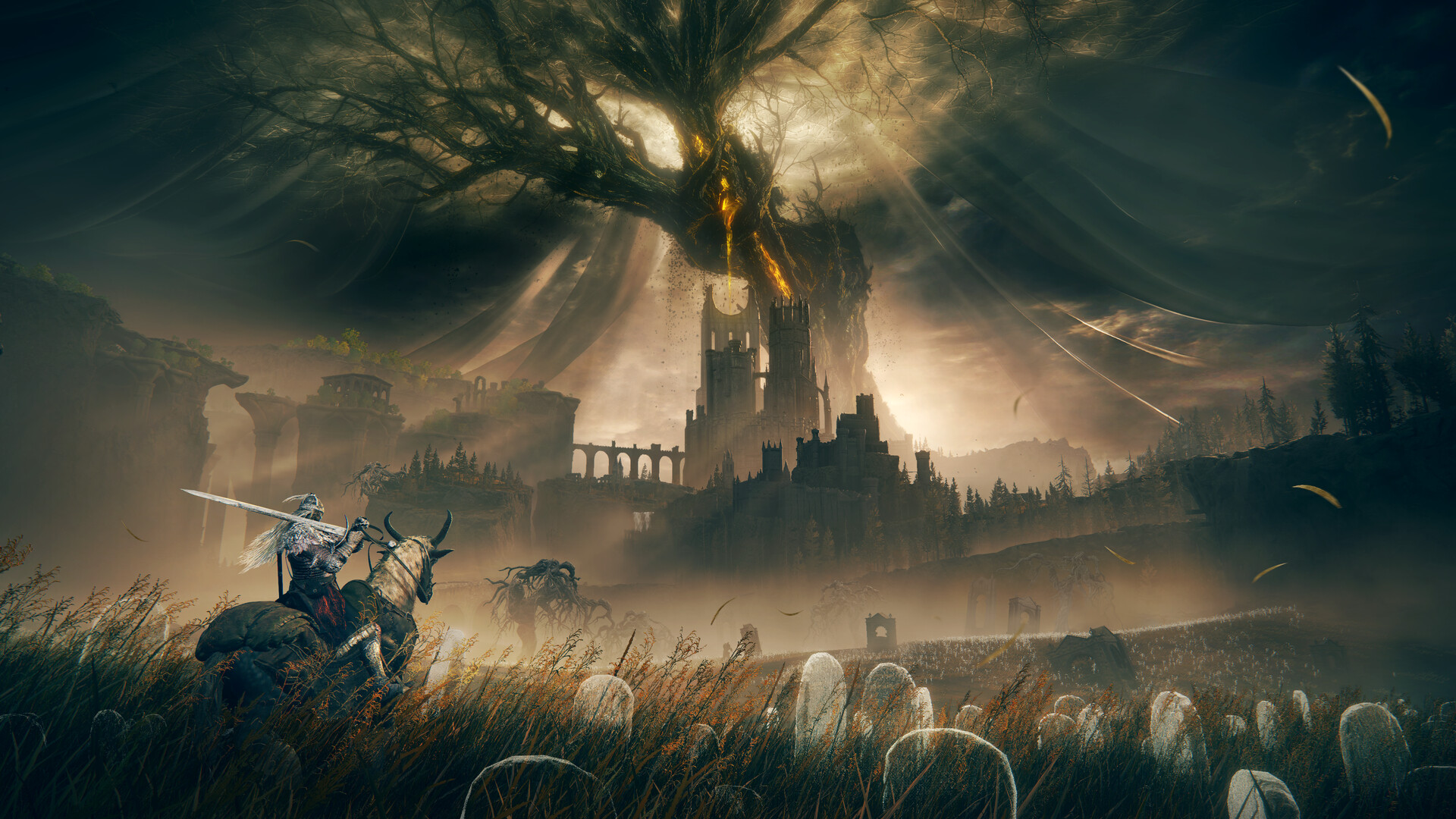
For those who arrive with the expected preparation, the transition is one of the most striking moments in recent gaming. The ritual to enter the Realm of Shadow — pressing your hand to the withered arm of Miquella in his cocoon — dissolves the familiar golden light of the Lands Between and replaces it with something fundamentally different: a landscape of perpetual amber twilight, the Shadow Erdtree rising on the horizon like a second sun, casting its glow over territory that is at once ancient and somehow wrong in ways that take hours to fully articulate.
The Realm of Shadow is massive. FromSoftware's description of it as "the size of Limgrave" understated its actual scope, which includes not only a large overworld equivalent in scale to the Lands Between's opening area but multiple legacy dungeons of substantial size, numerous smaller dungeons, and underground regions that rival anything in the base game for sheer visual ambition. A thorough playthrough of Shadow of the Erdtree takes twenty to thirty hours. A completionist run takes considerably longer.
World Design and Verticality
The Realm of Shadow is connected by FromSoftware's signature architectural logic — a world where no path is truly a dead end, where exploration always resolves into new understanding of the map's structure. The ruins of the Shadow Keep anchor the region's mid-section, and the network of connections around and through it rewards methodical exploration over map-following. Ledges that appear merely decorative conceal routes downward. Apparent dead ends reveal shortcuts. The satisfaction of the map gradually becoming legible is, if anything, stronger here than in the base game.
Three major legacy dungeons stand as the expansion's centrepieces. Shadow Keep is a burning fortress of extraordinary size, its interconnected halls and exterior ramparts filled with enemies and lore fragments that deepen the expansion's central mystery. Enir-Ilim, reached only in the expansion's final hours, is a structure of alien geometry and religious significance that ranks among FromSoftware's most conceptually striking environments. And Belurat, Tower Settlement, the expansion's first major dungeon, sets the tone with a densely constructed town that layers vertical traversal, enemy placement, and environmental storytelling with the precision the studio is known for.
Beyond the legacy dungeons, the overworld contains a variety of smaller locations that each deliver the moment of discovery that defines the FromSoftware experience. A flooded forest where ghost flames drift above still water. A primordial stone village that predates the current era of the world's history. A winter plateau ringed by ancient stakes. A series of catacombs below the main world that function as their own connected region. The density of discovery is extraordinary — there is always something to find, always another layer to the map.
The Scadutree Blessing System
Shadow of the Erdtree introduces a new upgrade system: the Scadutree Blessing, accrued by finding Scadutree Fragments scattered throughout the Realm of Shadow, and its companion the Revered Spirit Ash Blessing, which empowers your summoned Spirit Ashes. These systems function as a parallel progression track specifically for the expansion, separate from the rune level and weapon upgrade levels that govern your base game power.
The design intent is clear and, once understood, sensible: Scadutree Blessings ensure that players who explore thoroughly are proportionally more powerful than players who rush directly to bosses, and they create a reason to engage with every corner of the world rather than following the critical path. The expansion is calibrated assuming players will accumulate Blessings as they go, and the difficulty at max Blessing level is notably more fair than at minimum.
The reception to this system was initially contentious. Players accustomed to entering the expansion at high rune levels found their investment providing less protection than expected, and the mandatory nature of Fragment collection — the expansion is genuinely very hard without Blessings — felt to some like forced exploration rather than encouraged exploration. This debate obscures the reality that the system works: runs through the expansion that engage with its world fully are consistently more satisfying than attempts to skip directly to content, and the Blessings do meaningfully change the experience at higher tiers.
New Weapons and Build Diversity
Shadow of the Erdtree expands Elden Ring's already enormous weapon catalogue with dozens of new options, including several entirely new weapon categories. The Light Greatsword occupies a new niche between straight sword and colossal sword, offering swift two-handed swings with greatsword reach. Dueling Shields transform defensive items into offensive weapons, enabling a shield-based combat style previously unavailable. Great Katanas provide a heavy katana option for players who wanted the katana aesthetic with colossal weapon mass behind it. Backhand Blades introduce a fluid, acrobatic moveset built around reversed grips.
Beyond the new weapon classes, the expansion adds numerous individual weapons that rank among Elden Ring's finest. The Bloodfiend's Arm — a grotesque bludgeon with uniquely positioned stagger properties — found a devoted following among players who appreciate unusual damage profiles. The Smithscript weapons, a family of projectile-focused armaments, opened entirely new ranged combat approaches. And the DLC's boss weapons, acquired by defeating major encounters, each capture the mechanics and themes of their source fights in distinctive ways.
The Boss Gauntlet
Shadow of the Erdtree features ten named main bosses and over twenty optional encounters, and the quality concentration across this pool is the expansion's most remarkable achievement. From Software's boss design has always been exceptional, but the studio here operates at a level that would be notable even by its own standards.
Messmer the Impaler is the expansion's primary antagonist and one of FromSoftware's greatest boss designs. His first phase is a spear-and-fire duel of exceptional precision, each attack pattern legible after sufficient attempts, each punish window clearly earned. His second phase, which wraps him in serpentine appendages that recontextualise his moveset, raises the encounter's intensity to a peak and delivers an emotional crescendo commensurate with his narrative significance. He is remarkable in both conception and execution.
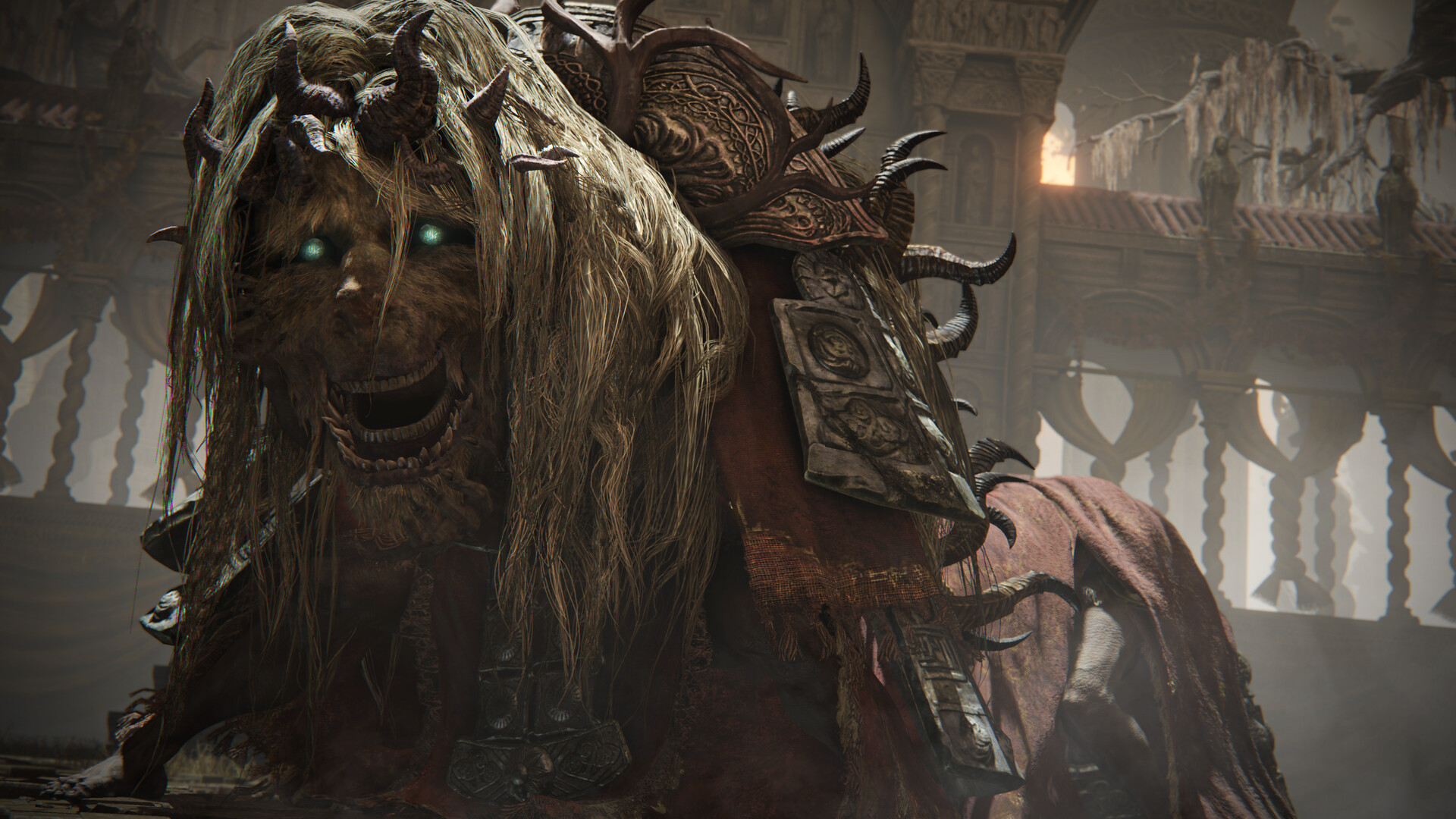
The Dancing Lion is a spectacle encounter — a divine beast that moves through multiple combat phases, each one deploying a different elemental magic while the music shifts to match. It is one of the most visually impressive fights FromSoftware has created, the kind of encounter that generates screenshots that don't quite convey what it's like to be inside it. Its mechanical demands are significant but the experience is worth the effort.
Midra, Lord of Frenzied Flame is a quieter but ultimately devastating encounter — a figure of tragic backstory encountered in a collapsing manor, whose transformation in the second phase into a manifestation of the Frenzied Flame is among the expansion's most resonant moments of environmental and combat storytelling.
The final boss — which will not be named here — is the expansion's definitive statement. It combines narrative significance, emotional weight, visual spectacle, and mechanical demand in a package that very few games at any scale can match. It requires mastery of the systems that the expansion has been teaching across its runtime, and it rewards that mastery with an experience that is, genuinely, unforgettable. The debate about its difficulty that erupted in the community upon release has somewhat obscured how good it actually is — which is very good indeed.
Lore, Narrative, and Miquella
Elden Ring's lore is dense, fragmented, and deliberately obscured, delivered through item descriptions and environmental details rather than explicit exposition. Shadow of the Erdtree expands on threads that the base game established — the history of Miquella, the nature of the Empyrean, the origins of the Shadow Erdtree and its relationship to the Golden Order — and does so with the elliptical precision that the community has come to expect and appreciate.
Miquella's role in the expansion is its narrative centrepiece, and the portrayal of his journey — his abandonment of his own flesh, his recruitment of devoted followers, his attempt to create a land of true compassion — is the most complex character examination FromSoftware has attempted in the Soulsborne series. The information arrives piece by piece, from enemy dialogue, from item descriptions, from the architecture of the spaces Miquella designed. Assembled, it forms a portrait of a figure whose intentions were genuine and whose methods became something else entirely — a tragic arc that earns its conclusion.
Technical Performance
Shadow of the Erdtree launched with modest performance issues on PC, particularly in specific areas of the Realm of Shadow where dense particle effects and geometry complexity created frame rate dips on hardware that ran the base game smoothly. These issues were largely addressed in patches within the first weeks of release. Console performance was more stable at launch, though the PS4 and Xbox One versions showed greater strain than the current-generation editions.
The expansion integrates seamlessly with the base game — there are no loading screens between the Lands Between and the Realm of Shadow beyond the ritual transition, and the systems, save files, and progression carry over without friction. This technical integration is exactly what it should be, and its invisibility is a testament to FromSoftware's technical work.
Criticisms and Honest Assessment
The expansion's difficulty sparked the most sustained community debate since Elden Ring's original launch. The combination of aggressive boss movesets, long attack chains, and damage tuning calibrated for Scadutree-blessed characters created an accessibility challenge that some players found prohibitive. The argument that difficulty is intrinsic to FromSoftware's identity is true but insufficient — the expansion's baseline at minimum Blessings can be genuinely unfair in ways that the base game, for all its challenges, was not.
Some optional bosses feel less polished than the main encounters. A handful of field bosses in the overworld reuse base game enemy models with inflated health and damage, offering less distinctive experiences than the major encounters. This is not unusual for open-world FromSoftware games — Elden Ring's base game had similar discrepancy between its headline encounters and its minor bosses — but it is notable in an expansion that otherwise maintains extraordinary quality.
The access requirements remain a genuine barrier. Players who want to experience the expansion but haven't defeated Mohg will need to engage with areas of the base game they might have avoided, and Mohg is not a simple encounter. This is a design choice, not a flaw — the expansion is built for players who have earned the ability to handle it — but it does limit the audience in ways worth acknowledging.
Verdict
Shadow of the Erdtree is FromSoftware at the absolute ceiling of their craft. The world design is extraordinary, delivering the signature experience of discovery and revelation that makes exploration in this studio's games uniquely satisfying. The boss encounters include some of the finest fights in the studio's history — and that is a very high bar. The new weapons and systems expand build diversity in ways that have revitalised the base game's endgame for players who had exhausted it. The lore additions are among the most substantive and thoughtfully deployed in the series.
More than any of these individual achievements, Shadow of the Erdtree demonstrates that expansion content can be genuinely great rather than merely supplementary — that the right studio, working at the height of its powers, can extend a masterwork in a way that deepens rather than dilutes the original. For existing Elden Ring players, this is not optional content. It is the rest of the game. It demands completion, and it earns that demand at every step.