
Licensed games have a long and mostly depressing history. For every good one, there are fifty cynical cash-ins that treat the property as a delivery mechanism for underbaked gameplay and call it a day. The reasons are structural: development timelines dictated by release windows, creative teams that don't necessarily love the source material, and commercial pressures that prioritise recognisability over quality. Knowing this history makes Indiana Jones and the Great Circle — which is not just good but exceptional, not just faithful but genuinely insightful about what makes the character work — all the more remarkable.
MachineGames, the Swedish studio behind the Wolfenstein revival, had demonstrated long before this project that they understood how to build a first-person game with personality and craft. The Wolfenstein games were character-driven action narratives with real emotional weight, technically proficient and artistically ambitious in ways that far exceeded what their commercial category typically demanded. When Bethesda announced that MachineGames would be developing an Indiana Jones game, the reaction from people who had played their Wolfenstein work was cautious optimism. Indiana Jones and the Great Circle has converted that optimism into something better: genuine admiration for a team that not only understood the assignment but exceeded it.
The Setting and Story
The Great Circle is set in 1937, between the events of Raiders of the Lost Ark and Indiana Jones and the Last Crusade — a gap in the canonical timeline that gives the game room to tell its own story without contradicting established events. The adventure begins at Marshall College, where Jones is teaching, and rapidly escalates into a globe-spanning mystery: someone has stolen a specific Egyptian artefact from the college museum, and the theft is connected to a larger pattern of thefts at sacred sites across the world.
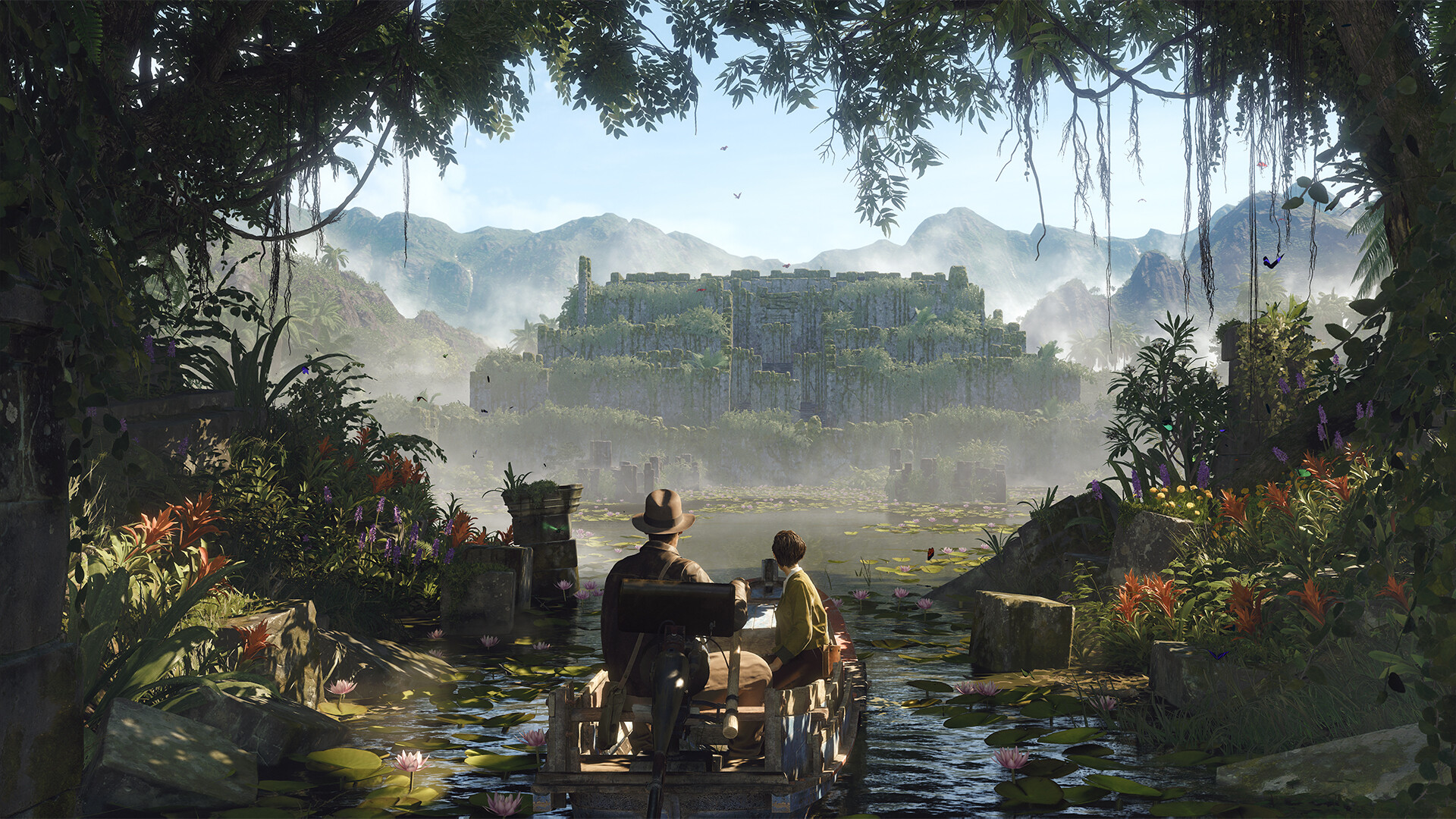
The titular Great Circle refers to a geographic pattern connecting these sacred sites — a concept drawn from archaeoastronomy and ancient cartography — and the investigation of what it means and what the antagonists intend to do with its power takes Jones from the Vatican catacombs to the deserts of Egypt to the jungle temples of Thailand to the snowy mountain passes of the Himalayas. Each location is rendered with extraordinary care for period detail, visual atmosphere, and cultural specificity. The Vatican sequences, set in early 1937 under the shadow of fascism's rise in Europe, capture the claustrophobic political atmosphere of the era with impressive subtlety. The Egyptian section breathes with the dust and heat and grandeur of the location. The Himalayan finale takes place against backdrops that rank among the game's most visually stunning.
The story is constructed with the proper Indiana Jones grammar: a central supernatural mystery, a rival antagonist pursuing the same objective for worse reasons, a companion with her own agenda that complicates the partnership, complications that escalate just as they seem to resolve. The villain, Emmerich Voss, is a believable figure — not a cartoon but an ideologue whose convictions are coherent even as his methods are monstrous. The companion, journalist Gina Lombardi, is the game's genuine co-lead, her arc as complete and as well-written as Jones's own.
Troy Baker's Performance
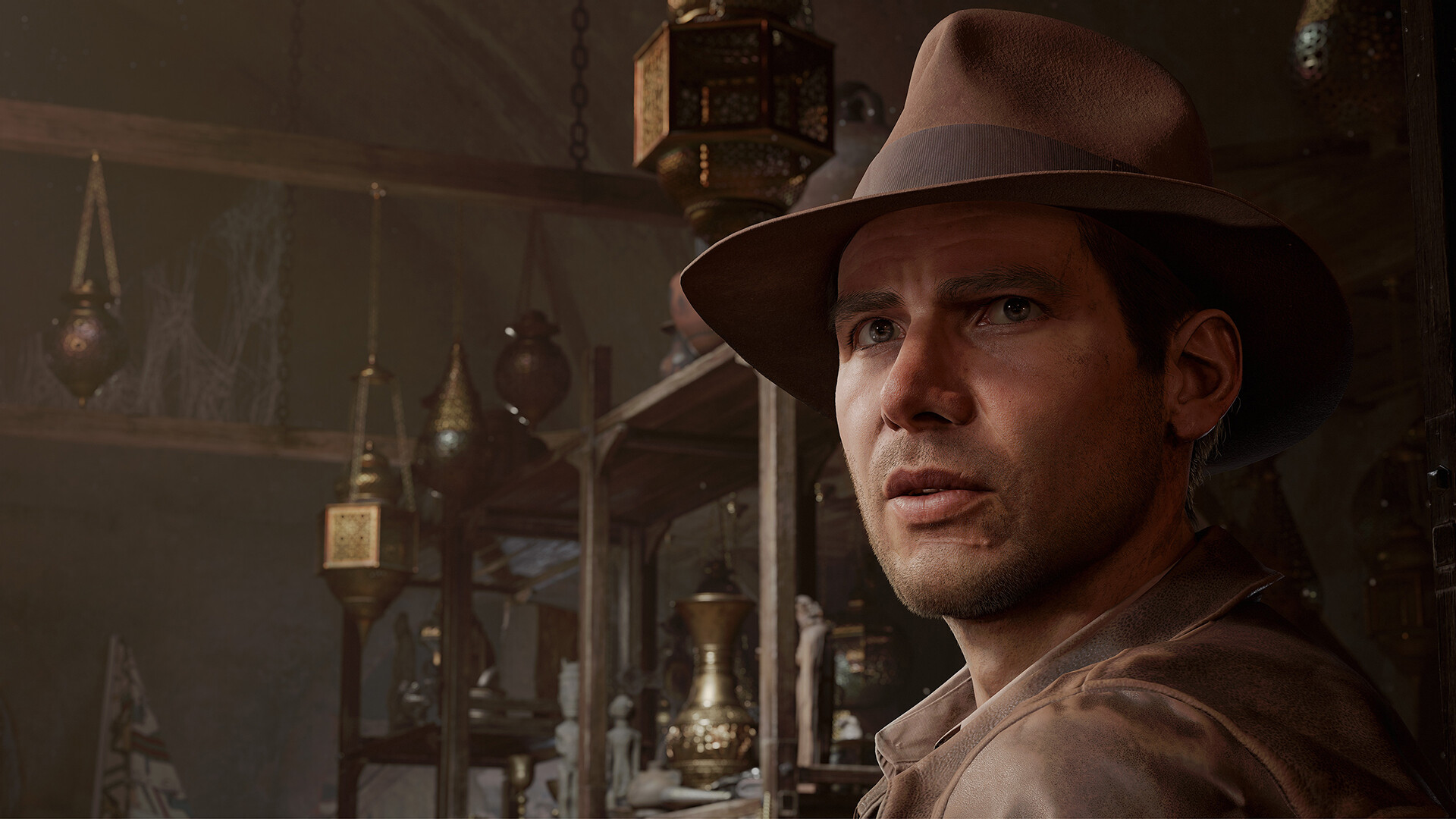
Casting Indiana Jones without Harrison Ford is a decision that requires justification, and MachineGames has provided it. Troy Baker, who provides both the voice and motion-captured performance of Jones, doesn't attempt to impersonate Ford — he is too experienced an actor to make that mistake. Instead, he captures the character's essence: the exasperated competence, the physical confidence that coexists with regular disaster, the dry wit deployed in situations that would render most people speechless, the specific quality of Jones's relationship to the supernatural (which he simultaneously believes in completely and refuses to find surprising).
Baker's performance succeeds in the ways that matter most. He makes Jones feel real in the way that great performance capture does — present in his body, specific in his reactions, consistent in his character logic across very different situations. The line delivery throughout is excellent, but it's the subtler work — the physical microperformances in quiet exploration scenes, the specific quality of Jones's focus when a puzzle presents itself, the authentic exasperation in combat when things go wrong — that elevates the performance from competent to genuinely good.
Ford has given the character his blessing, and the game features a brief scene with the original Indiana Jones's voice. It is handled with dignity and appropriate restraint, acknowledging the legacy without making the whole project feel like an extended impression.
The Whip: Mechanical Centrepiece
The whip is to Indiana Jones what the web-shooters are to Spider-Man: the character's defining tool, the one that communicates everything important about how the character engages with the world. Getting it right is essential to any Indiana Jones game, and MachineGames has not just gotten it right but made it the game's most inventive and consistent mechanical achievement.
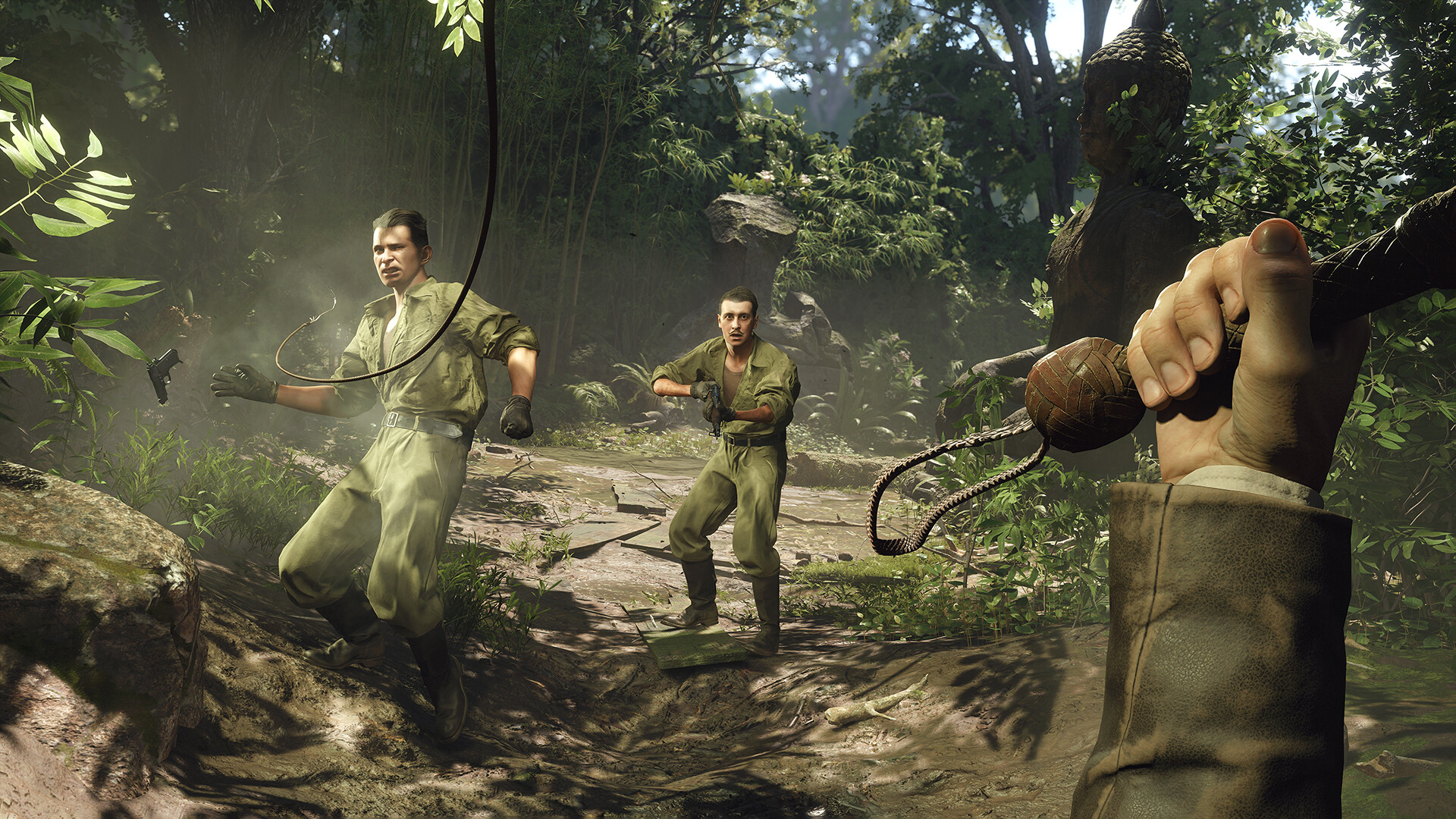
The whip serves multiple functions that evolve as the game progresses. In traversal, it attaches to structural anchors to enable swinging across gaps, lashing overhead beams to create rope bridges, and descending from heights with control that a free fall wouldn't permit. It serves as a crowd-control tool in combat — wrapping around enemy weapons to disarm them, tangling legs to trip, pulling shields away from guarding opponents to expose them. It solves environmental puzzles, activating mechanisms out of reach, pulling blocks into position, creating physical interactions with the world that feel clever rather than arbitrary.
What makes the whip extraordinary is how the game consistently finds new uses for it. A mechanic that appears fully developed in the first chapter reveals new applications in the fifth. The whip's physics feel genuinely tactile — the snap of it, the arc through the air, the satisfying crack on impact — and these physics are both visually impressive and mechanically relevant. Using the whip well makes you feel like Indiana Jones in a way that other mechanics in other games have failed to achieve even while trying harder.
Combat: Deliberately Imperfect
Indiana Jones's fights have always been defined by improvisation and inelegance. He doesn't flow through combat with martial artistry — he brawls, takes hits, grabs whatever's nearby, and wins through sheer determination and environmental awareness. The films make this explicit repeatedly: Jones wins his fights, but he gets hurt doing it, and the process is never clean or controlled.
The Great Circle captures this quality exactly. Combat is melee-focused, built around punches, kicks, the whip, and whatever happens to be in the immediate environment — crates, bottles, brooms, candelabras. Jones's attack animations have weight and consequence; there's a physical commitment to each punch that makes combat feel muscular without making Jones feel invincible. Getting hit matters. Positioning matters. And the option to disengage, to find a different approach, is always available.
Conventional firearms are in the game but deliberately limited. Jones has access to pistols and eventually other ranged weapons, but ammunition is scarce and Jones's proficiency with guns is presented as functional rather than elite. The game consistently encourages melee and environmental solutions over direct gunfighting, which is exactly the correct creative decision — Jones is not John Wick, and treating him as a cover shooter protagonist would fundamentally misread the character.
Some players have found the combat's deliberate messiness frustrating, particularly in encounters with large groups of enemies who deal significant damage before Jones can deal with all of them. This is, strictly speaking, accurate to the character — Jones does not win easily against groups — but the game's difficulty can feel punishing in ways that the films' action sequences, which Jones always survives regardless of the odds, don't prepare players for. The flexibility of the stealth system provides relief, but players who prefer direct confrontation will have a harder time.
Stealth and Disguises
The Great Circle's stealth system is more developed than the trailers suggested. Disguises — acquired from knocked-out guards, purchased, or found in the environment — enable Jones to walk through hostile territory that would otherwise require combat or avoidance. The disguise system has depth: different disguises grant access to different areas, and the suspicion meter that fills when you behave inconsistently with your assumed identity requires ongoing management. Disguised play turns the game into something like a social stealth puzzle, with Jones playing a role while looking for the information or item he needs.
The combination of stealth, disguise, environmental traversal, and direct combat creates an encounter flexibility that makes each area feel like a genuine problem to be solved rather than a prescribed sequence to be executed. How you approach the Vatican's restricted lower levels is up to you — through the sewers Jones discovered in the museum, through a disguise acquired from an incapacitated guard, by waiting for a patrol gap and making a dash, or by direct combat that trades stealth for speed. These choices aren't equally viable in every situation, but the game provides enough options that the player always has agency.
Puzzle Design
Adventure games have a reputation for puzzle design that ranges from inspired to infuriating — arbitrary solutions, pixel-hunting, illogical item combinations. The Great Circle's puzzles are neither arbitrary nor illogical; they are genuine tests of observation and lateral thinking that sit in the tradition of adventure game puzzles at their best.
The puzzle variety is wide. Ancient mechanisms require understanding the spatial logic of their design — gears, counterweights, pressure plates — before manipulation. Hieroglyphic and symbolic sequences require attention to established visual vocabulary. Environmental puzzles use the whip and Jones's tools creatively. Some of the most satisfying puzzles are structural: understanding the architecture of a space well enough to identify the non-obvious path through it, reading the environment as a text about how it was built and what it was built for.
The Vatican sequences feature the game's most elaborate puzzles, including a vault mechanism that occupies a significant portion of one chapter and requires assembling information from multiple locations before the solution is achievable. These extended puzzles, which feel like the adventure game equivalent of boss encounters, are where the game's puzzle design is at its most impressive. They require patience and observation rather than lateral-thinking leaps, and the satisfaction of cracking them — the moment of recognition when scattered information suddenly forms a coherent picture — is the game's version of a combat victory: earned, specific, and entirely satisfying.
World-Building and Historical Detail
MachineGames has done extraordinary research work on the environments and historical contexts of each location. The Vatican in 1937 is rendered with period-accurate architectural detail and political atmosphere — the relationship between the Papacy and Mussolini's Italy, the presence of Axis agents in Rome, the anxiety of a Catholic institution trying to maintain independence from totalitarian pressure. The Egyptian sequences engage with the history of early twentieth-century archaeology, including the legacy of colonial excavation practices that stripped local context from artefacts for European museums — a thread that becomes thematically significant as the story progresses.
NPCs populate each environment with dialogue that contextualises the political moment — conversations between guards that reflect their understanding of the current conflict, between locals that reveal the impact of Axis occupation on daily life, between Jones and his contacts that establish his relationship to the world he moves through. The game is interested in history not as backdrop but as living context, and this interest elevates the environmental storytelling above what most action-adventure games achieve.
Technical Performance and Presentation
The Great Circle launched with some PC performance issues, primarily affecting frame rates in densely populated outdoor areas on hardware below the recommended specifications. These were largely addressed in patches during the first month of release. The Xbox Series X|S versions — the game is a Microsoft exclusive console release — performed well at launch, with a performance mode hitting stable 60fps and a quality mode delivering higher visual fidelity at 30fps.
The game's visual quality, particularly in its environment design, is excellent. Lighting work across the diverse locations is a particular strength — the particular quality of Egyptian desert light, the warm interior glow of Vatican chambers lit by candles and stained glass, the cold blue-grey of Himalayan environments — each location uses light to establish atmosphere with the confidence of a production design team that understands cinematography.
Criticisms
The Great Circle is not perfect. The game's first chapter — the Marshall College prologue — is somewhat slow in establishing its rhythm, and the shift to the Vatican, which represents the game at its most confident, takes time to arrive. Players who bounce off the opening hour may not reach the game at its best.
Some late-game environments feel less thoroughly realised than the opening locations. The Himalayan sequences, while visually impressive, are more linear and less densely detailed than the Vatican or Egyptian environments, and certain areas feel like the development schedule required a compromise between ambition and completion that earlier areas didn't necessitate.
The balancing of non-lethal versus lethal approaches creates occasional tonal friction. The game encourages non-lethal resolution — Jones is explicitly not a killer, and the game rewards stealth and distraction over murder — but the transition from knocking out one guard to fighting five in direct combat and winning messily raises questions about the fiction's internal logic that the game doesn't fully resolve.
Verdict
Indiana Jones and the Great Circle is the best licensed game in years and one of the finest adventure games of its generation. MachineGames has produced something that functions not just as a faithful tribute to an iconic franchise but as an exceptional game in its own right — full of discovery, wit, and a genuine love for what made these stories matter.
The game understands Indiana Jones not as a set of aesthetic signifiers to reproduce but as a set of character qualities to embody: the competence-despite-chaos, the intellectual curiosity that drives him into danger, the physical resilience that gets him through it, the dry wit that makes the whole enterprise entertaining rather than grim. Everything in the game — the combat design, the puzzle logic, the traversal mechanics, the historical research, the performance — serves this characterisation. And when a licensed game achieves that level of coherence between its source material and its design choices, the result is something genuinely special.
Harrison Ford's Indiana Jones belongs to the films. Troy Baker's Indiana Jones belongs to The Great Circle. Both are Indiana Jones, and that is high praise indeed.