
There is nothing else that looks like MOUSE: P.I. For Hire. Fumi Games has spent years painstakingly hand-drawing every frame of this first-person shooter in the rubber hose animation style of 1930s theatrical cartoons, and the result is a game that feels less like playing a shooter and more like inhabiting a lost piece of animation history. But MOUSE is far more than a visual novelty — beneath the ink-and-cel aesthetic beats the heart of a genuinely excellent boomer shooter with surprisingly sharp detective mechanics.
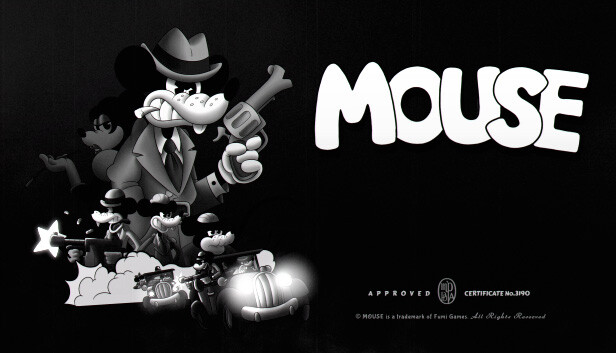
You play as Jack Pepper, a former war hero turned private investigator in the fictional city of Mouseburg. Troy Baker delivers one of his most entertaining performances as Pepper — world-weary, sardonic, and perpetually one wisecrack away from getting punched. When a routine missing persons case leads Pepper into the city's criminal underground, the noir narrative unfolds with genuine twists that kept me guessing through the 15-hour campaign. The supporting cast is equally memorable: a lounge-singing femme fatale, a crooked police chief with a glass eye, and a rival detective who might be the most insufferable character in gaming this year — in the best possible way.
The shooting mechanics are tight and responsive, channeling the best of the modern retro-FPS renaissance while carving out an identity entirely its own. Pepper's arsenal includes revolvers, tommy guns, shotguns, and an array of cartoon-inspired experimental weapons that defy physics in the best possible way. A boxing glove gun sends enemies ragdolling across rooms in exaggerated arcs. A portable hole can be placed on walls to create new pathways or on floors to drop enemies into the void below. An anvil launcher does exactly what you'd expect, and it never stops being satisfying. The weapon variety encourages constant experimentation, and the game rewards creative play with style bonuses that feed into an upgrade system allowing you to enhance Pepper's movement and combat abilities.

Level design deserves special praise. Each chapter takes place in a distinct Mouseburg location — a smoky jazz club, a waterfront warehouse stacked with contraband, a corrupt mayor's mansion dripping with gilded excess — and every environment is dense with secrets, alternate routes, and environmental storytelling. The hand-drawn art means every room feels curated rather than procedurally assembled, and the designers exploit the cartoon aesthetic to create impossible spaces that somehow feel internally consistent. Stairways loop back on themselves like Escher drawings. Doors open into rooms that shouldn't physically fit inside the buildings that contain them. It is level design that could only exist in a cartoon, and Fumi Games leans into that freedom with infectious enthusiasm.
Between combat chapters, investigation sequences slow the pace beautifully and provide welcome breathing room. Pepper examines crime scenes, collects physical evidence, photographs key details, and interrogates suspects in dialogue trees that actually affect how later levels play out. Accuse the wrong person, and you might face an ambush you could have avoided. Find a hidden clue, and a shortcut opens in the next combat level. Miss a piece of evidence entirely, and an optional boss encounter becomes mandatory. These aren't just narrative window dressing — they meaningfully alter gameplay in ways that reward attentive players and encourage multiple playthroughs.
The jazz soundtrack, featuring an original collaboration with French electro-swing band Caravan Palace, is phenomenal and deserves to be recognized as one of the year's best game scores. Tracks shift dynamically between moody investigation themes built around solo piano and muted trumpet, and frenetic combat arrangements that layer in driving drums, blaring horns, and distorted bass. The transition between exploration and combat is seamless, and the music is so good that the $39.99 Deluxe Edition's included OST feels like genuine added value rather than filler padding.
If there are weaknesses, they're minor but worth mentioning. Some boss fights rely too heavily on pattern memorization rather than the creative improvisation that makes standard encounters so enjoyable. The final chapter's difficulty spike feels slightly at odds with the otherwise smooth difficulty curve, introducing enemy types that punish the aggressive playstyle the game spent twelve chapters encouraging. The game also locks its PS4 and Xbox One versions behind a later release date, which may frustrate players on older hardware who have been following development.
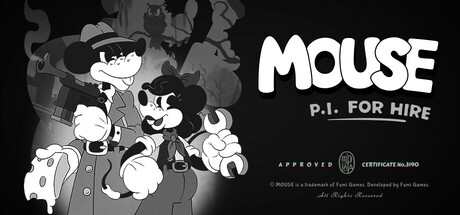
But these are small complaints against a game that delivers on virtually every front. MOUSE: P.I. For Hire is the rare title where the art style is not a gimmick but an integral part of the design philosophy — the cartoon logic that governs the visuals also governs the level design, the weapons, the humor, and even the narrative structure. It is a complete creative vision executed with extraordinary craft and genuine love for both its animation influences and its shooter heritage. In a genre increasingly crowded with retro-styled shooters, MOUSE stands alone as something truly original, and it sets a new bar for what indie studios can achieve when ambition meets execution.