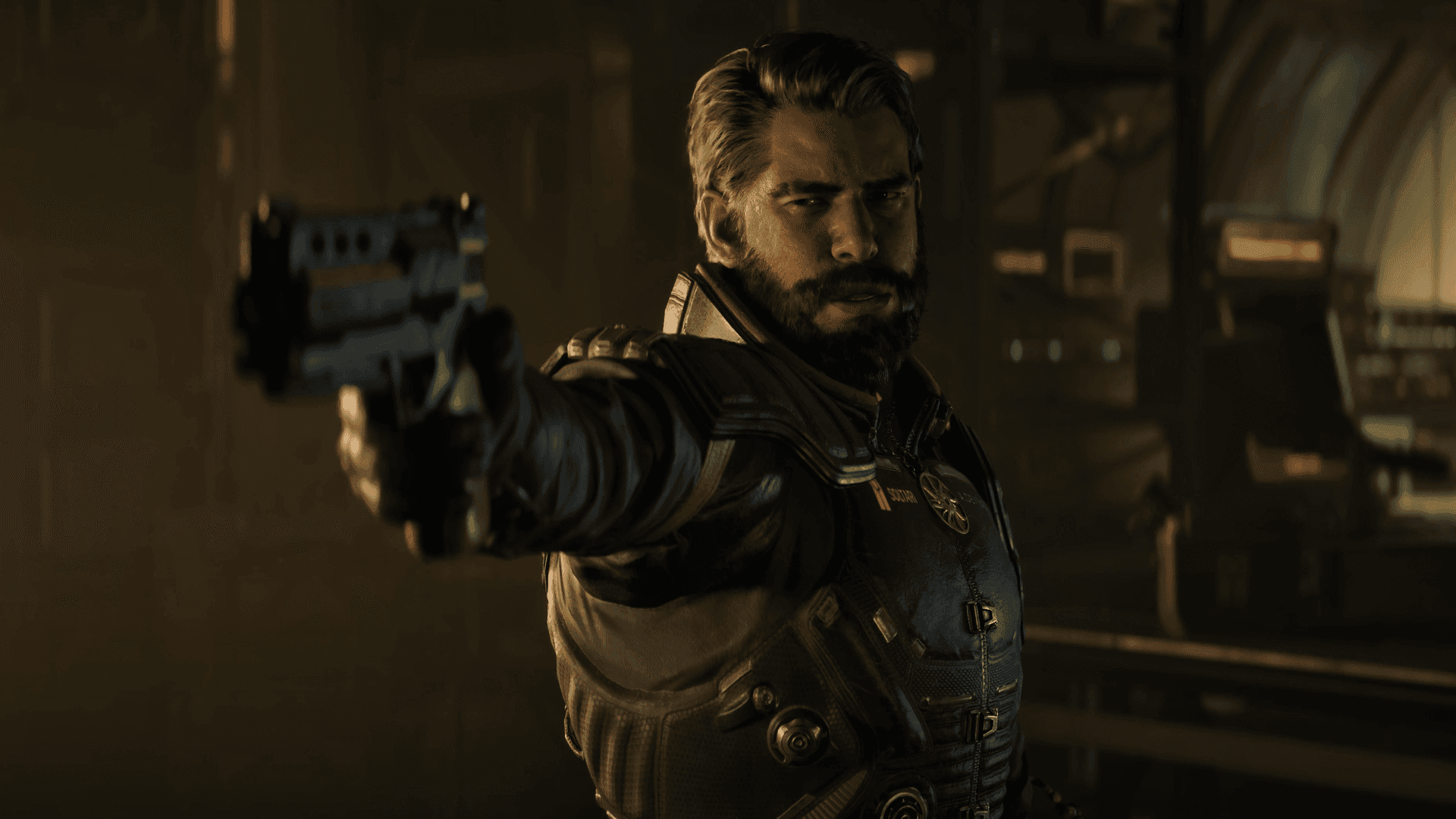
Saros arrives on April 30, 2026 carrying a weight that only sequels — spiritual or otherwise — to genuinely beloved games can. Housemarque's last PS5 outing, Returnal, was a divisive masterpiece: gorgeous, ferocious, and structured in a way that gated its story behind hours of bullet-hell mastery. Some adored it. Others bounced off so hard they never finished the first biome. Saros is the Finnish studio's answer to that conversation. It is not Returnal 2. It is something braver — a refinement of the same combat DNA wrapped around a roguelite that actually wants you to finish it.
After spending close to forty hours on Carcosa, dying to the same lieutenant nine times in a row, watching the eclipse swallow a biome and turn its geometry inside out, and finally — finally — collapsing the last anchor of a run that had no business succeeding, I can say with very little hedging: this is the best game Housemarque has ever made, and one of the best PlayStation 5 exclusives the platform has produced.
What Saros Actually Is
Saros is a third-person bullet-hell roguelite shooter set on Carcosa, an off-world colony that has stopped responding to the Soltari Order. You play Arjun Devraj, a senior Enforcer who arrives expecting wreckage and finds something much stranger: a world caught in a recurring solar event called the Saros eclipse, which loops local time, scrambles geometry, and erases everyone but him from the chain of memory. Each death snaps Arjun back to the moment of his arrival, but with fragments of what he learned still intact — a journal entry, a piece of equipment, a half-remembered face.
That's the framing the game gives you in its opening hour, and it's the trick that makes everything that follows work. The roguelite structure isn't a gameplay convenience awkwardly justified by a sci-fi macguffin (the Returnal problem). It is the story. Every run forward is also a run inward, and Housemarque has built dialogue, side beats, environmental storytelling, and even mechanical unlocks around the premise that Arjun is slowly becoming the only person on Carcosa who knows the truth.
If you played Returnal, you'll recognize the silhouette of the combat: tight third-person shooting, bullet patterns thick enough to occupy half the screen, a dash with i-frames, and weapons that level up the more you use them. If you didn't play Returnal, none of that should scare you off. Saros is significantly more welcoming, and the difference isn't a difficulty slider — it's a wholesale rethink of how the genre should treat its players.
The Bullet Ballet
Housemarque's combat director has called Saros a "bullet ballet," and after a few hours, the phrase stops sounding like marketing and starts sounding like a description. Enemy projectiles in Carcosa come in three colors, and each color demands a different verb. Blue bullets can be absorbed: hold the parry input as one approaches and Arjun pulls it into his Solenoid, the suit's storage matrix, where it becomes ammunition for a charged counterattack. Yellow bullets are dodge-only — your absorb won't catch them, and the dash's i-frames are timed precisely to slip through. Red bullets are the punishers. They cannot be absorbed, cannot be parried, and the dodge i-frames are too short to clear them cleanly. They demand pure positional reading, the kind of "be somewhere else when this happens" thinking that defines top-shelf bullet-hell design.
The trick is that all three colors share screen space at all times. A mid-tier engagement might have a Soltari Marauder spraying yellow tracking shots while a Husk Caster lobs red mortars and a swarm of Wisps puts down blue suppression. Surviving means triaging in real time: which projectiles do I dodge, which do I eat, where do I need to be in three seconds. When it works — when you absorb a wall of blue, dash through a yellow tracer, slide behind a pillar to break red lock-on, and then unload a charged shot back at the Marauder — it feels like a fighting game combo strung together at sixty frames per second. When it doesn't work, you eat a red mortar and the run ends, and you understand exactly why.
This color system is the single best mechanical decision Housemarque has made since the studio shipped Resogun. It does what difficulty sliders never can: it gives the player a vocabulary for reading the screen. The first hour is overwhelming. The fifth hour is rhythm. By the tenth, you're picking apart a screen-filling pattern the way a chess player reads a board, and the game's pace stops feeling chaotic and starts feeling readable. The bullet count never goes down — Carcosa is genuinely one of the most projectile-dense environments I've ever seen in a console game — but your relationship to that count changes completely.

Carcosa: A World That Earns Its Mystery
The setting deserves its own paragraph, because it's the thing that elevates Saros from "great roguelite" to something I think people will be writing about for years. Carcosa is a name borrowed from Robert W. Chambers' The King in Yellow, and Housemarque has done its homework. The world is half industrial mining outpost, half late-stage cosmic horror, and the seams between the two are where the game gets its texture. You'll round a corner in a perfectly normal cargo bay and find an obelisk humming with light that wasn't there last run. You'll walk past a control panel and notice that the pictograms have rearranged themselves. You'll find a Soltari corpse — your own division's uniform — propped against a wall holding a journal entry signed in Arjun's handwriting.
Each of the game's six biomes has a personality, and each of them changes substantially when the eclipse triggers. The eclipse is a timed event, roughly twelve to eighteen minutes into a run, where the local sky turns and the biome reconfigures around you. Architecture you've memorized over fifteen attempts suddenly has new corridors. Enemy types you've gotten used to fighting are replaced with their "umbral" variants, which are faster, hit harder, and use bullet patterns the base versions don't. Loot tables shift. Doors that were locked open. Doors that were open lock. The first time it happens, it's disorienting in the way a great horror game is disorienting. The second time, you start planning runs around it. By run thirty, you're choosing biome paths specifically because of where you want the eclipse to catch you.
It's the best procedural design twist I've seen in the genre since Hades introduced its god-pact gambits. It solves the chronic problem of roguelite biomes feeling samey by run twenty: Saros never lets a biome calcify, because the world itself is unstable.
Roguelite Done Right: Persistent Progression
The biggest practical change from Returnal is in how Saros handles progression between runs. Returnal notoriously gave you very little: a permanent ether currency, a few unlockable weapon traits, and a lot of frustration. Saros takes the opposite approach. Almost every system in the game has a persistent layer.
- Weapon mastery carries between runs. The Carbine you've been using for ten attempts will still be at level four when run eleven starts, with its alt-fire unlocked.
- Solenoid upgrades — the suit modifications that govern absorb capacity, dash count, and parry windows — are bought with a soft currency called Resonance, which you accumulate every run regardless of how it ends.
- Codex entries, journal pages, and audio logs stay collected. You can re-read them between runs from a hub area called the Anchor, which doubles as the game's narrative breathing room.
- Bonded NPCs are the most interesting addition. As you complete optional encounters, you build relationships with three other Soltari who are stuck in the same loop. Their dialogue, the gear they offer you, and the side missions they unlock all carry forward.
What this adds up to is the rare roguelite where a failed run still moves the needle, and not in the loose "you got a little stronger" sense — in the specific, narrative-aware sense that the next run will have new dialogue, a new beat, a new option you didn't have before. Housemarque has clearly studied Hades closely and adapted its lessons to a much faster, more punishing combat system. The marriage works.
That said, Saros is still a Housemarque game. The runs themselves are uncompromising. You will die a lot, and some of those deaths will feel cheap on the way to feeling fair. The persistent progression takes the edge off without taking the edge off, if that makes sense. You always lose your run-specific build — the parasites, the Solenoid charges, the temporary weapon traits — and the next run starts from a hard reset of those systems. The platform doesn't move under you, but you do have to climb it again.
Rahul Kohli Anchors a Genuinely Strange Story
Rahul Kohli plays Arjun Devraj, and he is the best thing in Saros. That's a strong claim for a game with this much going on visually, but Kohli's performance is the load-bearing wall holding up the entire narrative concept. Arjun is exhausted in the way a soldier is exhausted after the third tour, but he's also Arjun-exhausted — frayed by a private knowledge that no one else on Carcosa can hold for long. Kohli plays him quietly. There are no big speeches. No mid-run battle cries. Just a man who has been through this before, knows he will go through it again, and is working out, line by line, what exactly he's willing to do to break the loop.
The script gives him a lot to work with. The other Soltari NPCs — Vex, Demir, and Ailin — have full arcs that depend on which order you encounter them in and which side missions you choose to complete. Some of them die in some runs. Some of them turn on you. One of them, late in the campaign, asks Arjun a question I'm still thinking about a week after the credits, and the answer you choose locks in the game's ending. Housemarque has not made a story this good before. They have not made a story this complicated before. The fact that it works at all, layered on top of a roguelite combat system, is the kind of structural achievement worth pausing on.
Carcosa itself contributes. There are environmental beats — a recurring radio signal that mutates between runs, a series of murals that depict Arjun's journey before he's taken it, a child's voice that says his name from inside a sealed locker — that the game never explains and is right not to explain. Saros trusts you to sit with mystery, and it trusts the cosmic-horror aesthetic to do the heavy lifting on its own. It's the rare big-budget game that understands what made Bloodborne and Control work: leave space for the player.

PS5 Pro: A Showcase Title
I played most of Saros on a base PS5 and the last twelve hours on a PS5 Pro. Both are good. The Pro is something else. Housemarque has implemented Sony's PSSR upscaling tech in a way I haven't seen another studio match yet — the game runs at a single mode on Pro hardware, targeting 4K at sixty frames per second with PSSR doing the reconstruction, and the result is the cleanest, most stable image of any PS5 console game I've tested. The bullet effects in particular benefit. Saros's screen is constantly full of overlapping particles, and on the Pro the individual projectiles stay legible at distance in a way that the base PS5 (which targets 1440p / 60fps) sometimes loses.
The base PS5 version is still extremely good. Sixty frames per second is locked in both modes. The Performance mode on base hardware sacrifices some particle density and shadow detail; Quality mode trades a small amount of frame stability for full effects. Pick whichever you prefer; neither is a compromise that changes the feel of the game. The Pro, however, is the version Housemarque clearly designed for. If you have one, this is the kind of game that justifies the upgrade — the rare PS5 Pro showcase that actually showcases.
HDR implementation deserves a mention. Carcosa's color palette leans gold-and-violet, with bright bloom-heavy hits during the eclipse, and on a good HDR display the contrast is genuinely breathtaking. The Pro version supports DolbyVision gaming on compatible OLEDs, and Housemarque has tuned the HDR mapping aggressively — the eclipse sky in the third biome, when seen on a calibrated 4K OLED, is one of the most striking visual moments I've experienced on the platform.
Accessibility and Difficulty Modifiers
This is the section that most directly responds to Returnal's reputation. Saros ships with an accessibility menu that is, frankly, the most generous I've seen in a Sony first-party action game. The basics are all here: button remapping, hold-to-press toggles, colorblind modes for the all-important blue/yellow/red bullet system, full subtitle customization, screen-reader UI support, an on-demand pause that works during boss fights, and a high-contrast mode that strips backgrounds during heavy combat.
The bigger story is the gameplay modifier system, which sits separate from the difficulty selector. Modifiers let you adjust granular run parameters: enemy aggression, bullet density, parry window length, dash cooldown, even the eclipse timer. Toggling them does not lock you out of trophies or story progression. You can play a run with the parry window doubled and the eclipse delayed by ten minutes, and the game treats it as a legitimate completion. This is correct. This is how a game with this much teeth should be designed in 2026, and the fact that Housemarque — a studio whose previous game was effectively unplayable for some disabled players — built this system into the foundation of Saros is a quiet kind of victory worth celebrating.
Trophy hunters and combat purists are not left out. There's a "Soltari Verified" filter on leaderboards that only counts unmodified runs, and the hardest difficulty (called Eclipse Sworn) ratchets every parameter the other direction. I have not yet beaten a single biome on Eclipse Sworn. I am not sure I will. I am very glad it exists for the people who want it.
What Doesn't Quite Land
No game is uniformly good across forty hours, and Saros has its rough edges. The biggest one is also the thing reviewers have been most polite about: in-game cinematic dialogue scenes use character models that lack the fidelity of the voice performances driving them. Kohli's vocal work, in particular, frequently outpaces what Arjun's face can do. There are moments — the conversation with Vex in the second hub return, the late-game confrontation in the radio room — where the writing and performance are top-shelf and the in-engine animation simply can't keep up. It's not a dealbreaker. It is a noticeable gap.
I'd also flag that the middle stretch of the game, roughly hours twelve through twenty, can feel like a holding pattern if you're not engaging with the side content. The main loop is built around three "anchor confrontations" that gate progress, and the gap between the second and third can stretch if you're unlucky with biome rolls. Housemarque has clearly noticed this — there's a soft pity timer that increases the chance of anchor-relevant loot after several unsuccessful runs — but in my second playthrough I felt the slack more clearly than I had the first time. Engaging with the bonded NPC missions papers over it almost completely; players who skip side content in pursuit of the main quest will feel the dip more.
And — this is genuinely small — the Anchor hub is gorgeous to look at and slightly tedious to navigate. The space is large, the menus you actually use are clustered at one end, and you'll spend a lot of cumulative time walking back and forth between the journal terminal, the Solenoid bench, and the Resonance vendor. A fast-travel system inside the hub would have cost the studio nothing and saved players hours over a full playthrough. It's the kind of paper cut a patch should fix in the first month.
Finally, while the parry/absorb/dodge color system is excellent, the game is not generous about teaching it. The opening tutorial covers the basics in fifteen minutes, but several of the higher-level interactions — chained parries, the differences between umbral red and "true red" projectiles, how aura-shielded enemies refuse absorption — are taught entirely through death. If you go in cold, expect a frustrating first three hours. If you came from Returnal, you'll be at home almost immediately.
Boss Design: A Genuine High Point
I've been deliberately holding off on bosses because they deserve their own discussion. Each of Saros's six biomes culminates in an anchor confrontation, and three of those bosses are the best work Housemarque has ever shipped. The first biome's boss — a multi-phase encounter against something the codex calls the Choir of Spires — is the kind of fight that becomes a benchmark for the genre. It opens conventionally enough: a humanoid silhouette projecting bullet patterns from a central platform. Phase two splits the fight into a vertical arena where the boss occupies one tier and you have to use the absorb-and-charge cycle to break the platform between you. Phase three is where Housemarque shows what the studio can do — the entire arena geometry inverts, gravity rotates ninety degrees, and the boss reveals it was never the threat. It was the warning. The actual encounter is with the structure itself.
I'm being deliberately vague because spoiling these fights would be a real disservice. Suffice to say that the second biome boss is built around the eclipse mechanic in a way that genuinely surprised me, the fourth biome boss has a phase change tied to a story decision rather than a health bar, and the final encounter — a thirty-minute marathon across three arenas — is the rare boss fight in a roguelite where you genuinely do not want it to end. The fact that you can lose a run-in-progress to any of them and still come back later with stronger Solenoid loadouts and better mastery is what makes Saros's structure work. Bosses are not gates here. They're conversations. The game has a lot to say through them.
One specific design decision worth singling out: every boss has a "first encounter" cinematic that plays only on the first time you reach them, regardless of which run that happens to be. After that, subsequent encounters skip directly to the fight. This is a small thing that makes a huge difference. The story unfolds at the pace your runs do, not at the pace of an arbitrary linear progression, and the cinematic budget is reserved for moments that actually advance the plot rather than for filler.

Weapon Variety and Build Crafting
You start each run with the standard Soltari Carbine, a versatile mid-range weapon, and unlock additional firearms through a combination of permanent progression and run-specific drops. The full roster sits at fourteen weapons, each with a primary fire mode and a secondary "Resonance" mode that consumes Solenoid charge for a more powerful effect. The variety is genuinely satisfying. The Pulse Rifle's secondary creates a tracking projectile that homes through walls. The Tessellator splits its rounds along geometric lattices, hitting multiple enemies in a fan. The Echo Lance — my personal favorite — fires a beam that resonates against absorbed bullet types, multiplying damage based on what you've banked recently.
Build crafting in Saros is more deliberate than most roguelites. Instead of randomly stacking modifiers, you choose between three "Imprint" archetypes at the start of every run: Aggressor (favors close-range, melee-augmented builds), Architect (favors structural placement, deployable shields, environmental traps), and Witness (favors absorb-heavy, reactive builds). Each Imprint shifts the loot pool and unlocks Imprint-specific upgrades from vendors. Across forty hours, I've put serious time into all three, and they genuinely play differently — not "the same combat with different stats" differently, but "different decision-making cadence" differently.
The interaction between Imprints, weapon mods, and the bonded NPC perks creates a build space that's deep enough to support theory-crafting but constrained enough to keep run-to-run choices meaningful. I've seen builds online that I would never have constructed myself, and that's the mark of a roguelite that's gotten its progression mathematics right. Compare to Returnal, where weapon trait stacking was the entire build conversation: Saros has roughly four times the strategic surface area and uses every inch of it.
The Bonded NPC System Deserves Its Own Section
Vex, Demir, and Ailin — the three other Soltari you encounter on Carcosa — are the structural innovation that nobody is talking about enough yet. Each of them has roughly fifteen bond ranks, which you advance by triggering specific encounters in specific biomes during runs. As your bond rank with each NPC grows, three things happen: their dialogue evolves (you go from formal mission briefing to genuine personal conversation), their gear offerings expand (each NPC vends a unique tier of consumables and equipment), and their participation in your runs increases (at high bond ranks, they may show up as roaming allies during specific biome events).
The reason this matters: each bonded NPC has a personal arc that runs in parallel to the main quest. Vex is a former chronicler who's been on Carcosa longer than Arjun and is hiding why she stopped logging entries. Demir is a pragmatist whose loyalty to the Soltari Order frays the more he understands what's happening. Ailin is — well, Ailin is the most interesting of the three, and I'm not going to spoil her arc, but the late-game options her bond unlocks recontextualize a story beat from the first hour in a way that genuinely made me restart my second playthrough to catch the foreshadowing I'd missed.
The mechanical takeaway: you cannot fully complete every NPC's arc in a single playthrough. Choices you make affect which bonds advance and which don't. New Game+ exists partly to let you see the arcs you missed. This is the kind of design I'd expect from a CRPG, not from a bullet-hell roguelite, and the fact that Housemarque pulled it off without breaking the run-based structure is genuinely impressive.
The Solenoid System and Why It Replaces Returnal's Parasites
One of Returnal's most divisive systems was its parasites — high-risk, high-reward modifiers that gave you a benefit and a penalty. Some players adored them. Many of us hated them. Saros has replaced parasites with the Solenoid system, which is run-specific build modification done right. Your Solenoid is a suit module that holds three "matrix slots" at the start of each run, expandable to seven through mid-run upgrades. Into those slots, you fit Solenoid Cores: discrete modules with clear, readable benefits.
The system's elegance is in its constraint. Cores are not random stat boosts — they are mechanical interventions. The Echolance Core makes your charged shots ricochet off walls. The Halflight Core extends parry windows by 40% but reduces dash distance. The Anchor Core lets you absorb red bullets at the cost of one matrix slot during the absorption frame. Building a Solenoid loadout means deciding what kind of run you want to play, and the Cores you find mid-run reshape that decision in real time. By hour twenty, I had favorite Core combinations I'd actively scout for. By hour thirty-five, I had three different "loadout philosophies" I'd cycle through depending on which biome I was attempting.
This is roguelite build design at the genre's current peak. Hades II is the only game I've played recently that handles its run-specific buff system as cleanly, and Saros's is more strategic by some margin. If you cared about Returnal's parasites — for or against — you owe it to yourself to see how Housemarque has rebuilt that mechanical conversation here.

Sound Design Beyond the Soundtrack
I covered Koskinen's score above, but the foley and sound design deserve their own paragraph because they are doing some of the most important work in the entire game. Saros's combat is so visually busy that without exceptional audio cues, the screen would be illegible. Housemarque has solved this with a layered sound design that gives every projectile color, every enemy class, and every Solenoid interaction a distinct sonic signature. Blue absorb has a rising chime. Yellow tracking shots have a doppler whine. Red mortars have a sub-bass thud that you feel in your chest before you see them. The eclipse trigger is announced by a low, sustained tonal shift that warns you ten seconds before geometry actually changes.
On a good 5.1 or Dolby Atmos setup, this is one of the most spatially impressive games on the platform. I caught myself dodging incoming red bullets purely on audio cue several times — turning the camera was unnecessary because I could hear precisely where the shot was coming from. That's the level of sound design we're discussing, and it's what makes the genre's projectile density survivable as a player experience.
How Saros Compares to Returnal
This is the question every Returnal fan is asking, so I'll answer it directly. Saros is better. Not "Housemarque's evolution," not "a confident step forward" — straightforwardly, mechanically, and structurally better. The combat is sharper. The world is more interesting. The story integrates with the loop in a way Returnal's never quite did. Persistent progression solves the single biggest design tension that hung over the previous game. Accessibility is taken seriously. Boss design is more varied. The pacing is significantly tighter (you can finish a critical-path run in under an hour once you know what you're doing — a clean run of Returnal took close to ninety minutes, and a messy one could push three hours).
Returnal remains worth playing, especially in retrospect. Some of its specific atmospheric beats — the sirens of Atropos, the discovered house sequences — still hit harder than anything in Saros. Selene's story is more focused than Arjun's, which is sometimes a virtue. But if you bounced off Returnal for any structural reason — the run length, the lack of save mid-run, the brutal restart loop — the answer to "should I try Housemarque again" is unambiguously yes.
If you loved Returnal, the answer is even more emphatically yes. Saros is the version of that game's design language with all the friction Housemarque could carve away after four years of post-launch reflection, and what's left is sharper than the original was at any point in its lifecycle.
The Music, Briefly
Pietari Koskinen returns as composer, and he has done arguably his best work on this score. Carcosa's music is built around layered choirs, a glassy synth lead that sounds like a distant theremin, and a percussive bed that ramps with combat intensity. The eclipse trigger has its own theme — a slow, tonal collapse that resolves into something genuinely menacing — and the moment that motif drops in, run after run, never gets old. The Anchor hub gets a melancholic ambient piece that I caught myself humming away from the game. This is a soundtrack that will be in someone's GOTY list at the end of the year and rightly so.
Length and Replay Value
A first playthrough on standard difficulty, engaging fully with side content, will run somewhere between twenty-five and thirty-five hours depending on how quickly you click with the combat. The credits are not the end. Saros has two endings tied to a late-game decision, and accessing both requires a New Game+ run that introduces new biome modifiers, harder enemy variants, and roughly three hours of additional story content. The Eclipse Sworn difficulty unlocks after first completion, as does a daily challenge mode where the entire community runs the same procedural seed and competes on a global leaderboard.
I've put forty hours in. I've seen one ending. I have approximately a hundred more hours of optional content visible on my menus, and that's before the post-launch roadmap (which Housemarque has confirmed will include a free expansion called Carcosa Reawakened roughly six months in). For a $69.99 PS5 exclusive, the value proposition is unimpeachable.
Daily Challenge and Community Features
One feature I haven't seen many reviews discuss yet: the Daily Challenge mode, which unlocks after first completion. Every twenty-four hours, the entire Saros community runs the same procedural seed — same biome order, same modifier set, same eclipse timing — and competes on a global leaderboard. Daily seeds are deliberately mean. They tend to feature unfavorable Imprint requirements, restricted weapon pools, and increased eclipse density. Reaching the final boss on a Daily seed is, on average, harder than completing the standard campaign.
The leaderboard rewards both completion time and "Resonance score" — a points system that values stylish play (long combo chains, bullet absorption efficiency, no-hit phases) over raw speed. Watching the top of the leaderboard the day after launch was its own form of education; the level of play some people are bringing to this game already, on day one, suggests Saros is going to have a serious speedrunning and high-score community attached to it for years. Housemarque has confirmed weekly challenge events and seasonal modifiers as part of their post-launch roadmap, alongside the Carcosa Reawakened expansion mentioned earlier.
Cross-Save, Cloud, and Quality-of-Life
Cross-save between PS5 and PS5 Pro works flawlessly. PlayStation Plus cloud sync is supported. The game has a robust pause feature that works during boss fights — a meaningful change from Returnal, which famously did not — and the suspend-and-resume function preserves run state across console standby cycles. Suspending a run, putting the console to sleep, and coming back six hours later picks up exactly where you left off, eclipse timer and all. This single change probably accounts for more positive word-of-mouth than any other technical decision Housemarque made; Returnal's lack of mid-run save was, for many players, a dealbreaker, and Saros has resolved it without compromising the run-based design.
Verdict
Saros is the game Housemarque has been working toward for a decade. It takes the studio's signature obsession with arcade-perfect combat and lets it grow up — into a roguelite with consequence, into a story with weight, into a world worth caring about even when you're not currently dodging fifty bullets. It is one of the few games this generation that I would describe as both a refinement and a departure. It improves on Returnal in every measurable way, and it does so without losing what made the studio's voice distinct.
This is the PlayStation 5 exclusive of 2026 to clear your calendar for. If you own the console, you owe yourself this one. If you have a PS5 Pro, you'll see what the hardware was actually built to do. And if you've been waiting to forgive Housemarque for whatever Returnal did to you four years ago — they've done the work. The forgiveness is earned.
Score: 90/100. Easy contender for Game of the Year, and I'd be surprised if it isn't on the platform's permanent recommendation list a decade from now.